Sustainability Project in Partnership with Dominikus-Ringeisen-Werk
TUM Supports Innovation Campus for Circular Bioeconomy
From the TUM School of Natural Sciences, Prof. Tom Nilges, Prof. (em.) Johannes Lercher, and Prof. Jennifer Strunk are involved in the project. The researchers combine their expertise in innovative materials chemistry for batteries and hydrogen storage (Nilges), electrified reactors and catalysis for hydrogen production (Lercher), and chemical hydrogen storage and CO₂ conversion (Strunk). Together, they will analyze the potential of circular hydrogen technologies and electrical energy storage at the Ursberg site. The use of electrolyzers, battery systems, and strategies for material recovery from waste is intended to contribute to energy self-sufficiency and emission reductions.
“Tomorrow’s Solutions Take Shape in Everyday Life”
“We want to demonstrate that the future is not created in glossy brochures, but in everyday life - between workshop, field, and laboratory,” explains project coordinator Prof. Tom Nilges. His colleague Prof. Jennifer Strunk adds: “This project provides the opportunity to apply the technologies we develop in our laboratories in a concrete and meaningful way.”
“We are also explicitly considering the surrounding towns and communities and asking how and to what extent they can be integrated into the future energy supply,” says Michael Winter, Deputy Chairman of the DRW Executive Board.
A City in Miniature
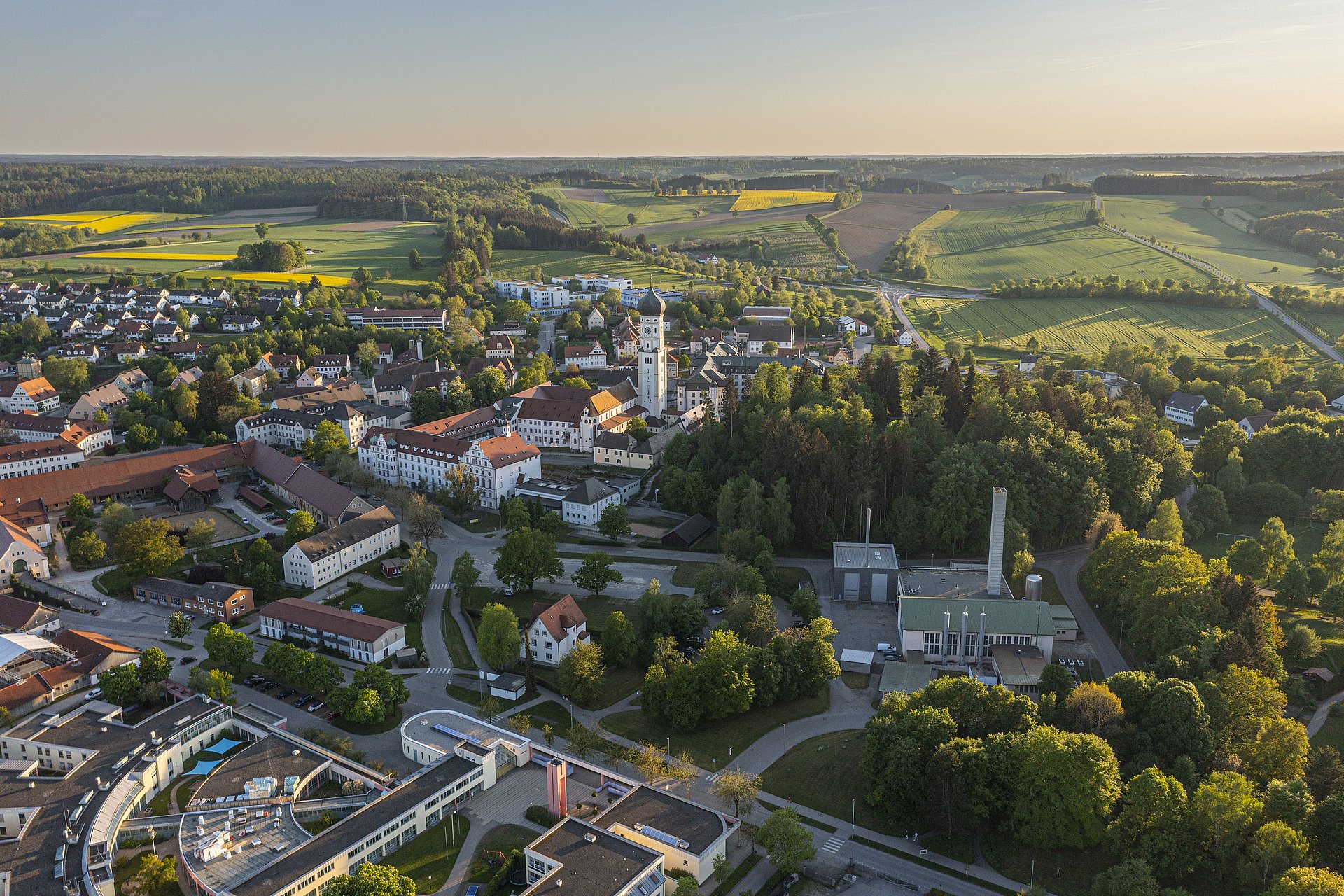
At the DRW campus in Ursberg, there are residential facilities, supported living arrangements, workshops and vocational training centers, skilled trades businesses, medical practices including a clinic, and additional services. The social services organization thus provides infrastructure comparable to that of a small city, including its own water supply and fire department.
This makes it possible to transfer the research findings as a model to other municipalities, businesses, or institutions. Funded by the German Federal Ministry for Economic Affairs and Energy (BMWE), the Living Lab aims to demonstrate how climate-friendly, affordable, and independent energy systems can be implemented in practice - particularly in institutions with social responsibility.
The project pursues three central objectives:
- Replacing fossil natural gas with renewable alternatives to enhance energy security.
- Reducing emissions by converting CO₂-intensive waste into usable energy and valuable materials.
- Developing transferable models for municipalities, social service providers, and small and medium-sized enterprises (SMEs).
The initiative will become part of the ministry’s Real-World Labs innovation portal and will demonstrate how circular energy systems can already be implemented today - not only as a technological solution, but as a key contribution to essential public services.
- Chair of Synthesis and Characterization of Innovative Materials
- Former Chair of Chemical Engineering II
- Chair of Industrial Chemistry and Heterogeneous Catalysis
- Project website “TUM goes DRW”
- The project “TUM goes DRW” – Energy Supply of the Future at Dominikus-Ringeisen-Werk is funded by the German Federal Ministry for Economic Affairs and Energy (BMWE).
- für Wirtschaft und Energie (BMWE) gefördert.
Technical University of Munich
Corporate Communications Center
- Ulrich Meyer
- presse@tum.de
- Teamwebsite
Contacts to this article:
Prof. Dr. Tom Nilges
Technical University of Munich
TUM School of Natural Sciences
Department of Chemistry
Chair of Synthesis and Characterization of Innovative Materials
+49 89 289 13110
tom.nilges@tum.de