Schools and Research Centers
Promoting pioneering research and readying talented minds to tackle the challenges of the future: this is why we networked our Schools and research centers across disciplinary boundaries – in a novel matrix structure that fosters innovation.
Schools at a glance
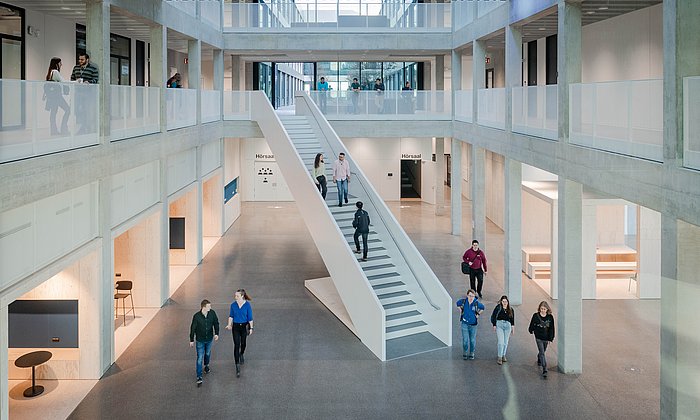
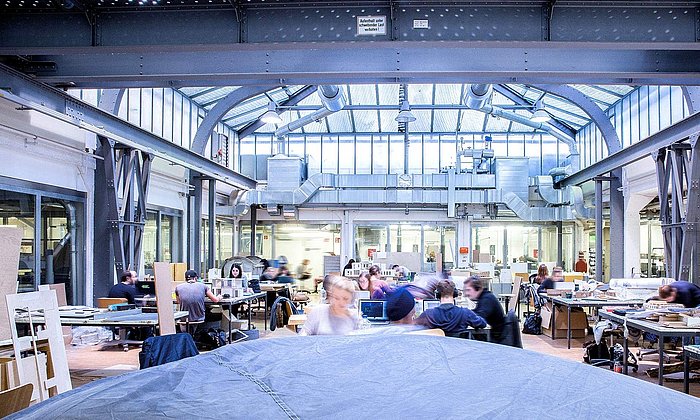
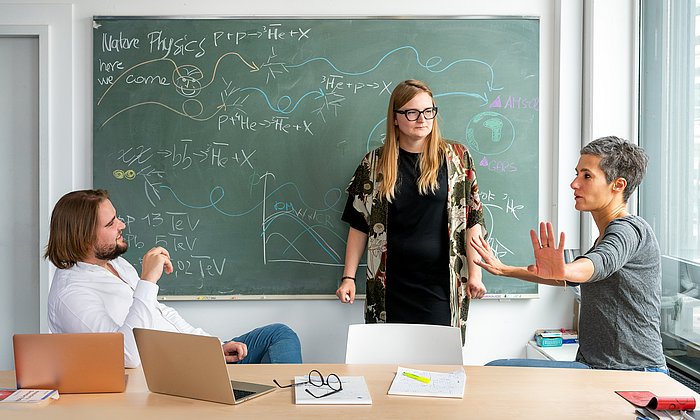
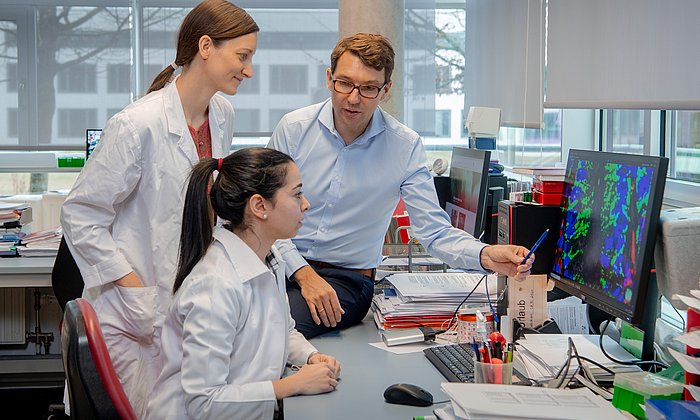
Seven Schools form the academic foundation of TUM and, with the departments within them, cover the major domains of science. This new structure breaks away from mono-disciplinary faculties. The Schools’ research and teaching focus on furthering sustainable innovation for the good of humankind, nature and society, with transdisciplinary connections forged by Integrative Research Institutes and other scientific institutions.
![[Translate to English:] Traktografien-Analyse](/fileadmin/_processed_/7/0/csm_Bild-3-20221031_Prof_Krieg_Gliom_Connectom_Analysis_AE_Z-306_5ea1ea8fd3.jpg)
TUM as a University of Excellence
A new direction for our university’s future
The TUM Agenda 2030 future concept, which we successfully realized during the last funding period, will now be further developed as TUM Agenda 2030+. Our new orientation towards 'society-centered research and innovation' creates effective solutions for the global challenges society is facing today: We are strengthening our focus on responsible, trustworthy and thus socially compatible innovations, engaging in dialog with the public, promoting talented individuals in all their diversity and working to achieve operational excellence on all levels.
Structure of TUM
Organization and Governance
How does TUM function as a modern scientific enterprise and one of the leading universities in Europe? From the TUM Executive Board to other bodies and central service institutions – get an overview of our university's overall structure.
Integrative Research Institutes
Situated at the interfaces between our Schools, Integrative Research Institutes (IRIs) tackle future-focused issues with far-reaching implications. They bring together approaches, tools and expertise from research and teaching in various subjects, striving to find novel solutions to system-wide challenges.
By teaching data skills paired with artificial intelligence, machine learning and basic research, the Munich Data Science Institute (MDSI) bundles the strengths of TUM in data science across disciplinary boundaries.
Associated institutes
As an Integrative Research Institute, the Munich Design Institute (MDI) brings together various academic disciplines and incorporates perspectives from the public through design and design research.
It integrates an understanding of behavioral science, manufacturing techniques, product development, technical design, rapid prototyping, and more to develop the creative abilities of students, researchers, and aspiring entrepreneurs. It also creates new, valuable effects on the design of technologies, products, software, processes, and change trajectories.
The Munich Institute of Biomedical Engineering (MIBE) brings together researchers from the fields of medicine, engineering, natural sciences and computer science. Together they develop and improve procedures for the prevention, diagnosis and treatment of diseases.
Associated institutes
The Munich Institute of Integrated Materials, Energy and Process Engineering (###MEP-Short###) combines research and development of modern materials and process engineering, sustainable energy systems and process design with the life sciences and their applications in biotechnology or medicine.
The Munich Institute of Robotics and Machine Intelligence (MIRMI) is dedicated to the development of intelligent machines to meet social challenges. Basic and applied research on robotics and AI always keep an eye on relevant disciplines such as ethics and law.
Associated institutes
Interdisciplinary research, teaching, as well as the the development of sustainable technologies and their economic implementation, taking into account ecological and social contexts, is carried out at the TUM Campus Straubing for Biotechnology and Sustainability (TUM-CS).