150 years of TUM – Stories from the 2018 anniversary
Messengers from outer space

Neutrinos – a new window to the universe
“Neutrinos are like messengers from outer space,” explains experimental physicist Elisa Resconi. “Our task is to decipher what they are saying.” The extremely lightweight elementary particles zoom through the universe at close to light speed, and their properties provide insights into the physical processes that catapulted them into outer space. Researchers like Resconi thus hope they can deepen our understanding of massive cosmic phenomena like supernovae, pulsars or active galactic nuclei. It is difficult to explore these phenomena with visible light, radio waves and x-ray radiation, because their photons are obstructed by intergalactic clouds and other barriers.
The problem with neutrinos is that they are hard to capture since they pass through matter without difficulty. The first evidence of high-energy neutrinos from beyond our solar system was obtained in 2012 with the massive IceCube particle detector in the Antarctic. One of the participants in the international project is the TUM research group led by Elisa Resconi. The researchers’ objective is to track down high-energy neutrinos – in other words, those that originate beyond our atmosphere and solar system and which could provide evidence of massive cosmic events in our galaxy or even further afield.
How the IceCube detector captures neutrinos
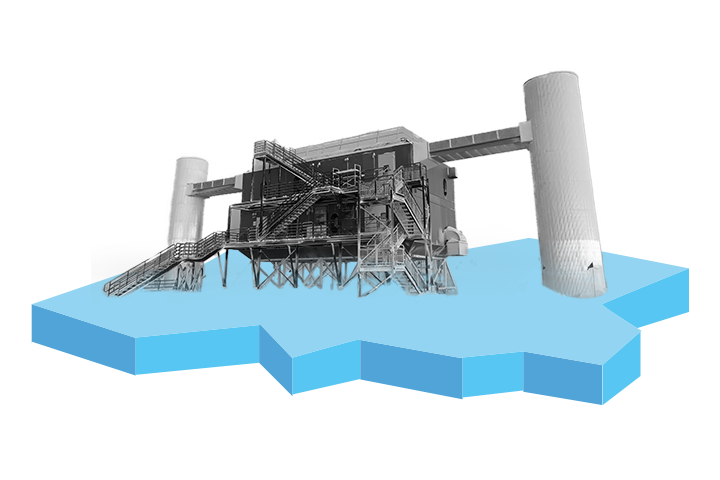
IceCube is probably the world’s most unusual telescope. It comprises 5,160 optical sensors, frozen into the permanent ice of the South Pole to register collisions between neutrinos and ice molecules. IceCube is massive in scale, extending over one square kilometer of ice. The idea is that the more matter the neutrinos pass through, the more likely it is that at least one of them will collide with another particle – and the IceCube detector will be there to record it.
Cherenkov radiation reveals ghost particles
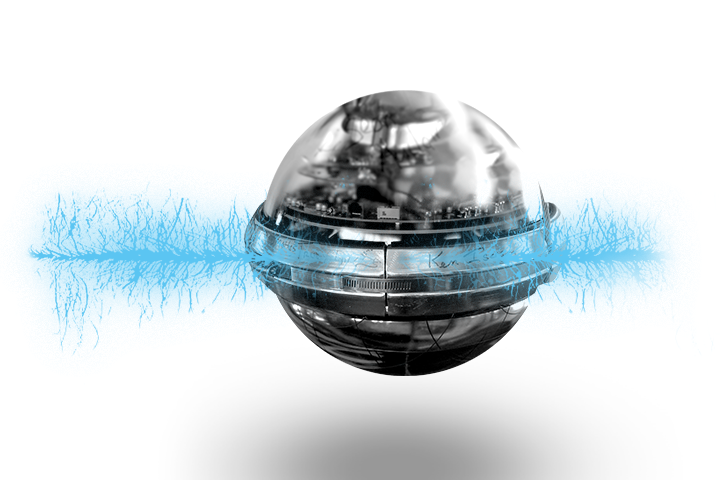
When neutrinos collide with ice molecules, charged showers of particles are the result. These create blue/ultraviolet radiation in the crystal-clear ice, known as Cherenkov radiation. This light is registered by the optical sensors, which are enclosed in basketball-sized glass orbs. These amplify the signals, convert them to electrical pulses and transform them into a digital signal within the detector. A high-precision clock accurately measures the arrival time of the neutrinos to within five nanoseconds.
The neutrino and the blazar
To date, IceCube has registered more than 80 neutrinos from the furthest reaches of the universe. Their exact origin remained a mystery, however, until recently. On September 22, 2017, the IceCube telescope recorded an energy-rich neutrino and was able to detect precisely where it emanated from: the TXS 0506+056 blazar, an active galaxy four billion light-years away. At the same time, other astronomical telescopes were measuring increased activity in this area, including particularly high levels of gamma radiation.
Further examination of older IceCube data and the region around the blazar confirmed TXS 0506+056 as the only possible origin of this neutrino. This marked the first time that researchers were able to identify the source of a cosmic particle: a huge achievement after more than a century of investigation. “Our research group played a major role in reaching this milestone,” confirms Resconi.


“Now we must determine where these neutrinos come from and how they are created. We are at the frontier of a new astronomy with neutrinos.”
Elisa Resconi, Heisenberg Professor of the German Research Foundation (DFG) at TUM for Neutrino Astronomy
Video: IceCube neutrino telescope detects origin of extragalactic particles (1'34 min.)
Just how is IceCube able to catch a neutrino coming from a blazar four billion light-years away? Our video explains it. (Copyright: TUM)
Disclaimer
This story was published in 2018 to mark TUM’s 150th anniversary on a jubilee website that has since been deactivated.
Text: TUM Web Communications Team; Graphics: KW NEUN

Literature on the history of TUM
- Wolfgang A. Herrmann (Hrsg.), Martin Pabst/Margot Fuchs (Verf.), Technische Universität München - Geschichte eines Wissenschaftsunternehmens, 2 Bd., Berlin 2006.
Link to the online catalog of the University Library - Wolfgang A. Herrmann, Winfried Nerdinger (Hrsg.), Die Technische Hochschule München im Nationalsozialismus, München 2018.
Link to free download via mediaTUM (PDF, in German, 79 MB)
Link to order the book
Link to copies in the University Library - Irene Meissner, Bauten+Kunst. Technische Universität München 1868-2018, München 2018. Link to the online catalog of the University Library
- Martin Pabst, Alumni der TUM. Prägende Gestalter aus der Technischen Universität München, München 2018. Link to the online catalog of the University Library
- Martin Pabst, Köpfe der TUM. Geniale Entdecker und Erfinder aus der Technischen Universität München, München 2018. Link to the online catalog of the University Library
- Brigitte Röthlein, Pioniere gestalten die Welt der Technik. 150 Jahre Forschung an der Technischen Universität München, München 2018. Link to the online catalog of the University Library
Further books and information on the history of TUM
Acknowledgements
We would like to thank everyone who helped us write the texts and create the visualizations. In particular, we would like to thank the authors of the books mentioned, the experts at the chairs, professors, staff, and press officers at the TUM Corporate Communications Center. We would also like to thank the staff of the Architecture Museum, the TUM German Heart Center, the TUM Klinikum rechts der Isar, the European Space Agency (ESA), and everyone else who provided us with expert advice and image material.
The anniversary stories were written by the TUM Web Communications team. The graphic content was created by KW NEUN – Designagentur.