150 years of TUM – Stories from the 2018 anniversary
High-speed pods

Three times faster than the competition
Imagine traveling from Los Angeles to San Francisco, from New York to Washington, or from Munich to Berlin in half an hour or even less. The hyperloop vision plans to dramatically accelerate travel times by propelling 30 or so passengers from A to B in pods speeding through massive tubes.
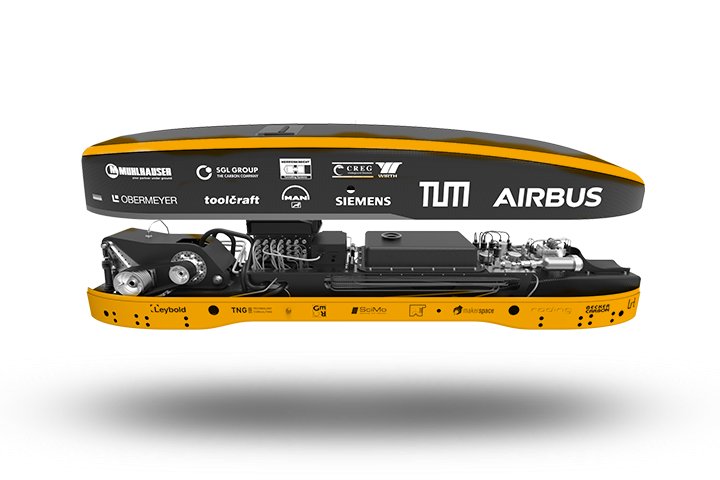
Keen to fast-track the high-speed capsule idea, Elon Musk launched the Hyperloop Pod Competition in 2015. Teams of students from around the world were invited to submit their designs for hyperloop transport pods. The top three prototypes then competed against each other on a test track in California in January 2017. TUM’s WARR Hyperloop team were declared the winners when their pod recorded the fastest speed of 94 km/h.
When the next competition rolled around in August 2017, a new team of TUM students managed to repeat their predecessors’ success. This time, the pod reached a speed of 324 km/h, three times faster than the nearest competitor. The TUM hyperloop pod set a new world record to boot – topping the highest speeds achieved by commercial developers.
How does the hyperloop work?
The hyperloop is a transport system that shoots pods along a tube maintained at a partial vacuum. The low air resistance means that speeds of up to 1,200 km/h – close to the speed of sound – are achievable. For Elon Musk’s competition, a 1.25-kilometer test tube was specially built so the teams of students could pit their prototypes against each other.
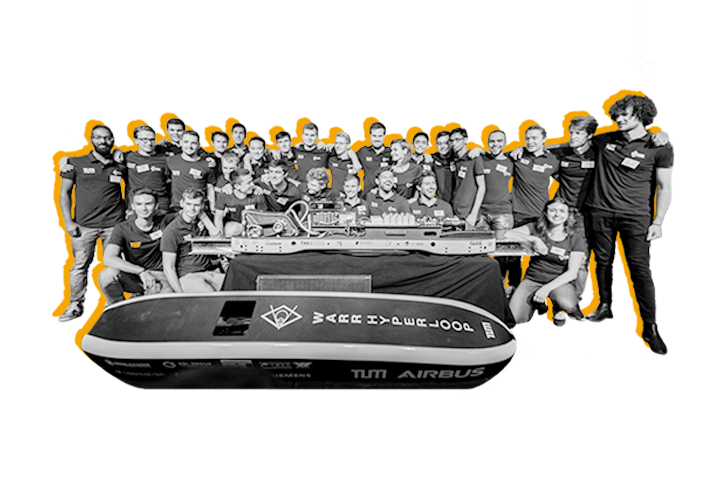
Who is behind the TUM pod?
The hyperloop pod is the latest project undertaken by the WARR student research group (a scientific workgroup for rocket science and space travel). The workgroup gives students from a variety of science disciplines an opportunity beyond their studies to acquire practical experience and apply their theoretical knowledge. WARR’s previous projects include a space elevator and Germany’s first hybrid-propellant rocket.
Next stop for hyperloop?
Following their resounding wins in the first two Hyperloop competitions, WARR is preparing for the next round of the pod challenge. A new team is working on a completely different pod design, which they hope will again beat the efforts of the world’s best student groups. The hype around hyperloop at TUM shows no signs of losing pace.
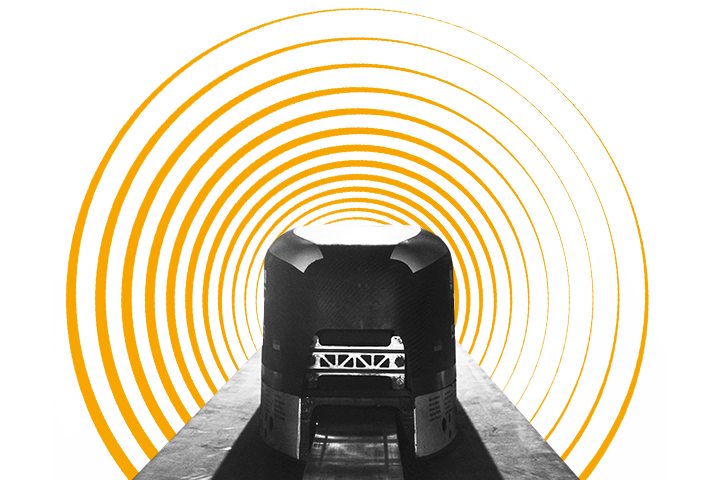
Video: WARR Hyperloop reaches 324 km/h (0:26 Min.) (as of 2018)
Disclaimer
This story was published in 2018 to mark TUM’s 150th anniversary on a jubilee website that has since been deactivated.
Text: TUM Web Communications Team; Graphics: KW NEUN
Literature on the history of TUM
- Wolfgang A. Herrmann (Hrsg.), Martin Pabst/Margot Fuchs (Verf.), Technische Universität München - Geschichte eines Wissenschaftsunternehmens, 2 Bd., Berlin 2006.
Link to the online catalog of the University Library - Wolfgang A. Herrmann, Winfried Nerdinger (Hrsg.), Die Technische Hochschule München im Nationalsozialismus, München 2018.
Link to free download via mediaTUM (PDF, in German, 79 MB)
Link to order the book
Link to copies in the University Library - Irene Meissner, Bauten+Kunst. Technische Universität München 1868-2018, München 2018. Link to the online catalog of the University Library
- Martin Pabst, Alumni der TUM. Prägende Gestalter aus der Technischen Universität München, München 2018. Link to the online catalog of the University Library
- Martin Pabst, Köpfe der TUM. Geniale Entdecker und Erfinder aus der Technischen Universität München, München 2018. Link to the online catalog of the University Library
- Brigitte Röthlein, Pioniere gestalten die Welt der Technik. 150 Jahre Forschung an der Technischen Universität München, München 2018. Link to the online catalog of the University Library
Further books and information on the history of TUM
Acknowledgements
We would like to thank everyone who helped us write the texts and create the visualizations. In particular, we would like to thank the authors of the books mentioned, the experts at the chairs, professors, staff, and press officers at the TUM Corporate Communications Center. We would also like to thank the staff of the Architecture Museum, the TUM German Heart Center, the TUM Klinikum rechts der Isar, the European Space Agency (ESA), and everyone else who provided us with expert advice and image material.
The anniversary stories were written by the TUM Web Communications team. The graphic content was created by KW NEUN – Designagentur.